Trending

The baskets tucked behind the ballfields at Dale's Riverside Park catch discs most evenings, and on a warm Saturday the parking lot fills with people who look like they have been doing this for years. Plenty of them haven't. Disc golf is one of the few sports you can try on a whim — no tee time, no reservation, no membership — and Riverside is a good place to find out whether you like it. Here is what a first round actually looks like.
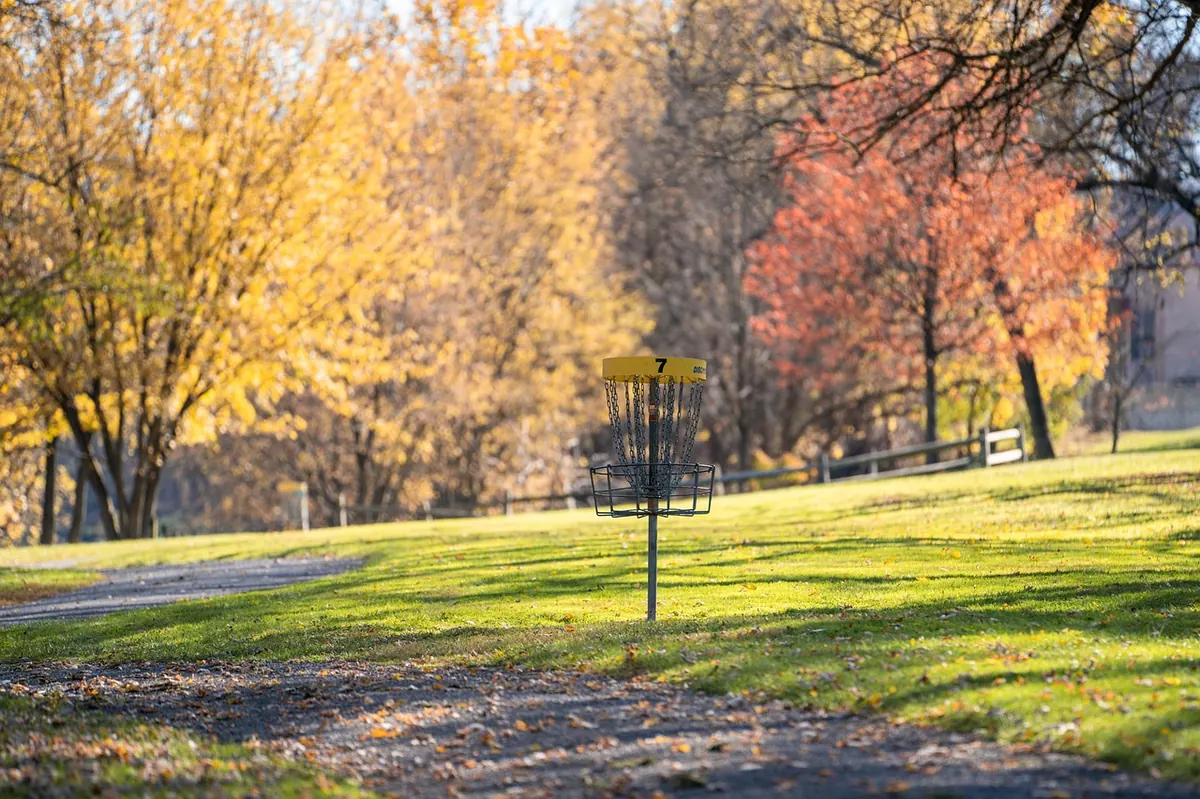
Disc golf borrows the shape of ball golf and swaps out the equipment. You throw from a marked tee pad toward a basket, count every throw, and finish the hole when your disc comes to rest in the tray or hanging in the chains. The basket itself is a metal pole with a ring of chains over a shallow tray, and the chains are there to catch a well-aimed putt before it sails through.
Each hole has a number and a par, and most are par three. That means a solid player expects to reach the basket in one throw and sink the putt in two. Nobody expects that of you on your first trip. Play the hole, count honestly, and move along.
Discs are not Frisbees. They are denser, thinner, and shaped with a rim that changes how they fly. Walk into a shop and you will see hundreds of them, which is exactly why beginners should ignore most of the wall. Three discs cover an entire round:
Skip the high-speed distance drivers for now. They need more arm speed than a new player has, and they tend to dive left or right out of your hand before they go anywhere useful. Lighter discs in the 150 to 170 gram range are easier to control. If you would rather not buy anything yet, ask around at the course on a weekend. Most regulars carry discs they never throw and will gladly hand you one to try.
Riverside's layout plays as a loop. The opening stretch runs across the mowed grass near the ballfields, where wind is the main obstacle, then the course turns into the trees along the creek, where accuracy matters more than power. The loop swings back near the parking lot partway through, so you can stop after nine holes without a long walk home.
Every tee has a sign showing the hole number, the par, and a rough map. Read it before you throw. Two things matter most: where the basket sits and where the trouble is. At Riverside, trouble is usually water, thick brush, or a walking path. When a path crosses the fairway, look both ways and wait for it to clear.
Write your name and phone number on the back of every disc with a permanent marker. Plastic disappears into the creek and the brush regularly, and a marked disc usually finds its way home.
New players try to muscle the disc. Fight that instinct. Smooth, flat throws travel farther than hard, wobbly ones, and the wobble is what sends most first throws into the trees.
Spend ten minutes in the open field near the parking lot before you start the course. Aim at a tree, then a bench, then the trash can. That is enough practice to make your first tee shot less nerve-wracking.
The course is free and open to everyone, which means everyone has to be a little considerate. These rules cover almost everything that comes up:
None of this is complicated. The etiquette exists so a hard piece of plastic does not hit anyone, and so a slow group does not spoil a fast group's evening.
Wear shoes with grip, bring water, and set aside about an hour for nine holes. Weekend afternoons at Riverside are the busiest; weekday mornings and early evenings are quieter, and the light through the trees along the creek is better then anyway.
For a first round, keep expectations low and the score loose. Play with a single disc if you want to simplify things. Bring a friend who is also new, because two beginners laughing at bad throws beats one beginner stewing over them. Use insect repellent in summer, watch for poison ivy off the fairway, and if you have a shoulder or back issue, warm up slowly and check with a doctor before you start throwing hard. Otherwise: throw, walk, throw again. That is the whole sport, and most people who try it at Riverside come back the following week.
Photo: jatocreate / Pixabay